

Hey there! As a supplier of clipped sine wave TCXOs, I often get asked about the frequency response of these nifty little devices. So, I thought I'd take a deep dive into this topic and share some insights with you all.
First off, let's quickly go over what a clipped sine wave TCXO is. A TCXO, or Temperature-Compensated Crystal Oscillator, is a type of oscillator that uses a crystal resonator to generate a stable frequency. The "temperature-compensated" part means it can maintain a pretty consistent frequency even when the temperature around it changes. A clipped sine wave TCXO, on top of that, produces a clipped sine wave output. This kind of output has some unique characteristics that make it useful in a variety of applications.
Now, let's talk about frequency response. Frequency response is basically how a device responds to different frequencies. For a clipped sine wave TCXO, the frequency response tells us how the output frequency behaves when we vary the input or when there are changes in the operating conditions.
One of the key factors that affect the frequency response of a clipped sine wave TCXO is the clipping process itself. When a sine wave is clipped, it introduces harmonics. Harmonics are frequencies that are integer multiples of the fundamental frequency. For example, if the fundamental frequency of our sine wave is 10 MHz, the second harmonic will be 20 MHz, the third harmonic will be 30 MHz, and so on.
The presence of these harmonics can have a significant impact on the frequency response. In some cases, the harmonics can cause unwanted interference or distortion in the output signal. But in other applications, these harmonics can actually be put to good use. For instance, in some wireless communication systems, the harmonics can be used to generate additional frequencies for different channels.
Another important aspect of the frequency response is the stability of the output frequency. A good clipped sine wave TCXO should have a high degree of frequency stability over a wide range of temperatures and operating conditions. This stability is crucial in applications where precise timing is required, such as in telecommunications and navigation systems.
The frequency stability of a clipped sine wave TCXO is typically specified in terms of parts per million (ppm). For example, a TCXO with a frequency stability of ±1 ppm means that the output frequency can vary by no more than 1 part per million from the nominal frequency. This is an incredibly high level of stability, and it's one of the reasons why clipped sine wave TCXOs are so popular in high - precision applications.
Now, let's take a look at some of the products we offer as a clipped sine wave TCXO supplier. We have the Clipped Sine Wave TCXOs 7050 10 Pins. These TCXOs are known for their excellent frequency response and high stability. They are designed to operate in a wide temperature range, making them suitable for industrial and outdoor applications.
Our Industrial Temperature TCXOs 2520 are another great option. These TCXOs are specifically designed for industrial environments where the temperature can vary significantly. They have a very low phase noise, which means that the output signal is very clean and free from unwanted fluctuations. This low phase noise contributes to a better frequency response and overall performance.
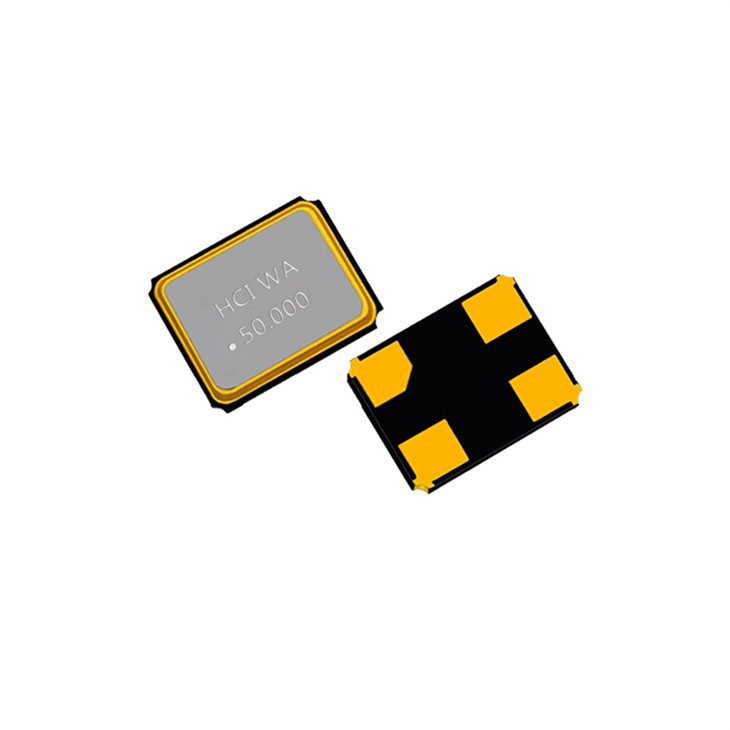
And then there's the Clipped Sine Output TCXO Oscillator 3225. This oscillator is a compact and reliable option for applications where space is limited. Despite its small size, it still offers a high level of frequency stability and a good frequency response.
When it comes to measuring the frequency response of a clipped sine wave TCXO, there are several methods. One common method is to use a spectrum analyzer. A spectrum analyzer can display the frequency components of the output signal, allowing us to see the fundamental frequency as well as the harmonics. By analyzing the spectrum, we can determine the amplitude and phase of each frequency component, which gives us a detailed picture of the frequency response.
Another method is to use a frequency counter. A frequency counter can measure the output frequency of the TCXO with high precision. By taking measurements at different temperatures and operating conditions, we can plot the frequency response curve and analyze how the output frequency changes over time.
In addition to these measurement methods, we also use advanced simulation tools to model the frequency response of our clipped sine wave TCXOs. These simulation tools allow us to predict the behavior of the TCXO under different conditions and optimize the design to achieve the best possible frequency response.
As a supplier, we understand the importance of providing high - quality clipped sine wave TCXOs with excellent frequency response. That's why we invest a lot of time and resources in research and development to continuously improve our products. We also have a strict quality control process in place to ensure that every TCXO we produce meets the highest standards.
If you're in the market for a clipped sine wave TCXO, we'd love to hear from you. Whether you're working on a small - scale project or a large - scale industrial application, we have the right product for you. Our team of experts is always ready to help you choose the best TCXO for your specific needs and answer any questions you may have about frequency response or other technical aspects. So, don't hesitate to reach out and start a conversation about your procurement requirements.

References
- "Oscillator Design and Computer Simulation" by Reinhold Ludwig and Pavel Bretchko
- "RF Circuit Design: Theory and Applications" by Chris Bowick